
- Home
-
Fire Door Hardware Guide: Essential Components And Selection for Commercial Projects
Views: 0 Author: Qi An Publish Time: 2026-08-05 Origin: Site


Introduction
A fire rated door does not work in isolation. The door leaf and frame are only two parts of a larger assembly. Without the correct hardware â hinges that hold under load, closers that shut reliably, locks that stay latched during a fire â the assembly fails at the moment it is needed most.
Building codes in most countries require fire doors to be tested and certified as complete assemblies. This means the hardware specified during the fire test must match the hardware installed on site. Swapping components after certification invalidates the rating.
For project managers and procurement teams working on commercial construction, selecting compatible fire door hardware is not an afterthought. It is part of the fire safety specification from the start. This guide covers the components that make up a fire door hardware set, how to select them for different building types, and what standards govern their use.
What Is Fire Door Hardware?
Fire door hardware refers to all the functional components fitted to a fire rated door assembly â hinges, closers, locks, exit devices, seals, bolts, and coordination devices. Each component serves a specific purpose, and all of them must be tested together as part of the certified door assembly.
When a fire door undergoes a fire resistance test under standards such as UL 10C, EN 1634, or BS 476, the test applies to the entire assembly â not just the door leaf. The hinges, the closer, the lock body, the intumescent strips, and the frame are all present during the test. If any of these components is substituted after certification, the test report no longer applies.
The practical consequence for construction projects is that hardware cannot be sourced independently from the door supplier without risking non-compliance. Procurement teams who separate the door order from the hardware order create a gap between what was tested and what gets installed.
Essential Fire Door Hardware Components
Fire Door Hinges
Hinges on a fire door carry more load than standard door hinges. A commercial fire door assembly â steel leaf, steel frame, fire core, plus hardware â can weigh over 100 kg. Under fire conditions, the hinges must maintain alignment so the door stays in its frame and the intumescent seals can expand to close the gap.
Fire rated hinges are typically made from stainless steel or steel with a corrosion-resistant finish. They are tested to remain functional at the temperatures reached during a standard fire test. The number of hinges per door depends on door height and weight; most fire doors use three hinges minimum, with taller or heavier doors requiring four.
Ball-bearing hinges reduce friction and wear in high-traffic installations. For exterior fire doors exposed to weather, stainless steel grade 304 or 316 hinges prevent rust that could compromise the hinge under fire conditions.
Fire Door Closers
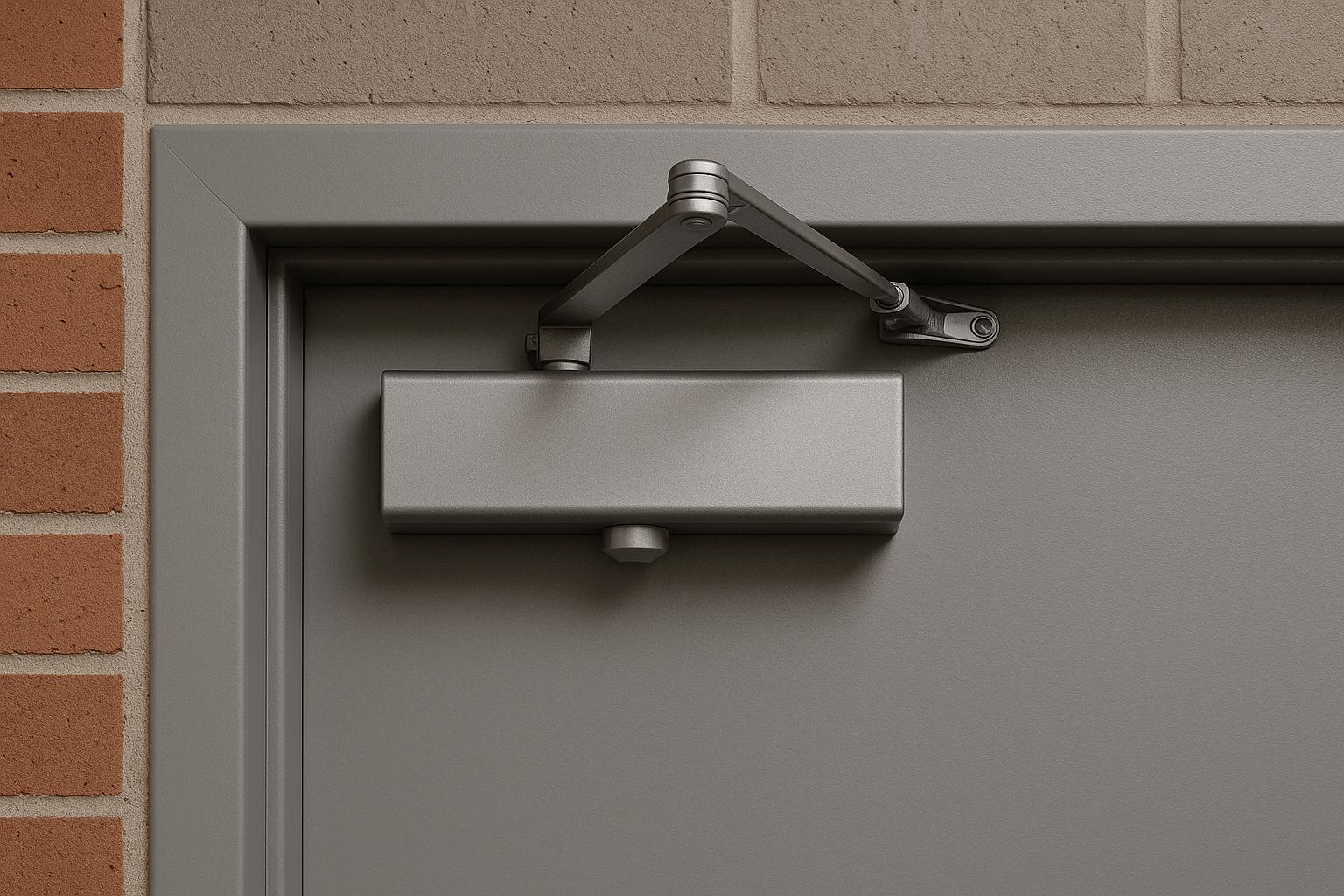
A fire door that does not close fully provides no fire protection. Door closers are the mechanism that ensures the door returns to the closed and latched position after every use â automatically, without relying on someone remembering to pull it shut.
Surface-mounted overhead closers are the most common type in commercial buildings. They are installed on the pull side of the door and use hydraulic damping to control closing speed. Concealed closers, fitted inside the door leaf or frame, are used where appearance matters â hotels, executive offices, hospital patient rooms.
Backcheck and delayed action features control how the door behaves when opened forcefully or held open. Adjustable closing force allows the closer to be tuned for different door weights and wind conditions. For smoke control, closers must close the door against the resistance of smoke seals and any pressure differential caused by the fire.
Fire door closers used in corridors, stairwells, and compartment walls must be tested as part of the fire door assembly. A closer that works on a standard door may not provide adequate closing force on a heavier fire rated door with intumescent seals.
Fire Door Locks and Exit Hardware
Locks on fire doors serve two functions that can conflict: security and emergency escape. The lock must prevent unauthorized access under normal conditions, but it must also allow occupants to exit quickly during a fire without keys, codes, or special knowledge.
Panic exit devices (panic bars or push bars) are required on fire doors serving assembly spaces, schools, and other buildings where large numbers of people may need to exit quickly. A horizontal push on the bar retracts the latch, and the door opens in the direction of egress. These devices must be fire rated and tested with the door assembly.
Mortise locks and cylindrical locks are used on fire doors where security is the main concern â mechanical rooms, electrical closets, storage areas. The lock case and strike plate must be fire rated. Standard locks can fail during a fire if internal components melt or seize.
Electromagnetic locks (maglocks) hold fire doors open under normal conditions and release when the fire alarm activates, allowing the closer to shut the door. They are common in hospital corridors and commercial building hallways where doors need to remain open for daily traffic but must close during a fire. Maglocks must be connected to the building fire alarm system and release on power failure.
Fire Door Seals
Intumescent seals are strips fitted into grooves in the door edge or frame. At normal temperatures, they sit flush with the surface. When exposed to heat â typically above 150°C â the intumescent material expands to many times its original volume, filling the gap between door and frame.
This expansion prevents smoke and hot gases from passing through the gap. Smoke is the primary cause of death in building fires, so smoke seals are often combined with intumescent fire seals in a single strip. Cold smoke seals â brush or fin seals that work at ambient temperatures â prevent smoke migration before the intumescent material activates.
Seal placement depends on the door type and fire rating. Single-acting doors typically have seals in the frame or on the door edges. Double doors need seals at the meeting stile where the two leaves come together. The seal specification must match the gap dimensions in the door assembly as tested.
Flush Bolts and Coordinators
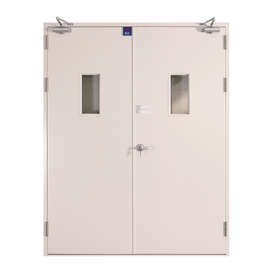
Flush bolts secure the inactive leaf of a pair of fire doors. They are recessed into the door edge and engage with the frame at top and bottom. During a fire, both leaves of a double door must remain closed to maintain the fire rating, so flush bolts must be fire rated and coordinate with the door closer sequence.
Door coordinators ensure that the active and inactive leaves of a double door close in the correct order. The active leaf must close after the inactive leaf, so the leaves overlap correctly and the seals align. Without a coordinator, the inactive leaf may prevent the active leaf from closing, leaving a gap.
Threshold seals close the gap at the bottom of the door. Drop seals, which lower when the door closes, are common on doors that need a level threshold for wheelchair access during normal use but must seal against smoke during a fire.
How to Select Fire Door Hardware for Different Projects
Hardware selection depends on how the door is used day to day, not just how it performs during a fire. A fire door in a hospital corridor opens and closes hundreds of times a day. A fire door in a plant room may open once a week. The hardware must be specified accordingly.
Hospitals
Hospital fire doors operate under conditions that test hardware to its limits. Corridor doors may cycle 200 to 400 times per day as staff, patients, and equipment move through. The hardware must withstand this frequency without degrading closing performance or developing play in the hinges.
Hygiene requirements add another constraint. Surface-mounted hardware should have minimal crevices where contaminants can collect. Stainless steel components resist the cleaning chemicals used in healthcare environments. Hold-open devices linked to the fire alarm system keep corridor doors open for patient transport but must release reliably when the alarm activates.
Smoke control takes priority in hospitals because patients cannot be evacuated quickly. Fire door seals must prevent smoke migration between compartments. Closers must overcome the additional resistance of smoke seals and any air pressure differences created by HVAC systems.
Hotels
Hotel fire door hardware must balance safety with guest experience. Guest room entry doors need fire ratings combined with acoustic seals, quiet-closing mechanisms, and finishes that match the interior design. A door closer that slams shut in the middle of the night generates complaints. Adjustable closing speed and quiet latch mechanisms solve this.
Corridor fire doors in hotels are often held open by electromagnetic devices and released on fire alarm. These doors must close gently enough to avoid injury but firmly enough to latch. Door coordinators on double doors in ballroom and conference areas ensure that large door pairs close and seal correctly.
Visual consistency matters. Hinges, closers, and exit devices should be available in finishes that match the door hardware throughout the hotel. Concealed closers are common on guest-facing doors where surface-mounted hardware would disrupt the design.
Commercial Buildings
Office towers, retail centers, and mixed-use buildings present high-traffic conditions similar to hospitals, but with greater variation in door types and hardware requirements. Stairwell doors must close and latch after every use, so closers and hinges need to handle heavy use with minimal maintenance.
Security is a higher concern than in hospitals. Access control integration â electric strikes, card readers, electromagnetic locks â must work with the fire door hardware without compromising the fire rating. If the access control system fails, the door must still close and latch mechanically.
Compliance documentation is critical for commercial projects. Building inspectors and fire marshals require evidence that the installed hardware matches the tested assembly. Procurement records should link each hardware component to the door schedule and the fire test report.
Industrial Facilities
Factory and warehouse fire doors face conditions not seen in commercial or institutional buildings. Forklift traffic, vibration from machinery, and exposure to dust, chemicals, and temperature extremes all affect hardware performance and service life.
Heavy-duty hinges with sealed bearings handle the weight of large steel fire doors and resist contamination from dust and debris. Closers specified for industrial use have higher closing force and more robust hydraulic systems to handle wind loads from open loading bays and pressure differences in large volume spaces.
Corrosion resistance matters in food processing plants, chemical storage areas, and coastal locations. Stainless steel hardware prevents rust that could seize hinges or degrade closer mechanisms. Regular inspection and maintenance are essential â industrial hardware sees more abuse and requires more frequent checks than hardware in office environments.
Fire Door Hardware Standards
Fire door hardware certification follows the same international standards that govern fire door assemblies. Hardware is not tested in isolation â it is tested as part of a complete door assembly.
UL Standards (North America)
Under UL 10C, fire door assemblies are tested with all hardware installed. UL-listed hardware carries a marking that identifies the fire rating it was tested with. For projects in the United States and Canada, hardware must be UL listed and matched to the door assembly's UL classification label.
EN 1634 (European Union)
EN 1634 tests fire doors under the same principle: the complete assembly, including hardware, is subjected to furnace conditions. Hardware for EN 1634 classified doors is tested in the specific configuration â hinge type, closer model, lock body â that will be used on site. Changing any component requires re-testing or an engineering assessment.
BS 476 (United Kingdom)
BS 476 Part 22 follows a similar approach. British Standards require that hinges, locks, and closers used on a fire door are of a type and specification referenced in the fire test report. For Commonwealth projects specifying BS 476 doors, the hardware must also be sourced within the same certified configuration.
AS 1530.4 (Australia)
Australian standards impose one of the strictest regimes for fire door hardware. AS 1530.4 requires that the door assembly be tested in the swing direction as installed. Hardware â hinges, locks, closers â must be identical to the test sample. Australian regulators routinely ask for full test evidence, not just a certificate, during building inspections.
The common thread across all standards is the same: a fire door is a system. The door leaf, frame, and hardware must be sourced as a matched set, tested and certified together.
Why Choose Qi'an Door for Fire Door Solutions
Guangdong Qi'an Door Industry Co., Ltd. has manufactured fire rated doors for engineering projects for more than 20 years. The company supplies complete fire door assemblies â door leaf, frame, and compatible hardware â as a single package. This reduces the coordination burden on project managers and removes the compliance risk that comes from sourcing hardware separately.
Qi'an Door's engineering team provides CAD drawings and hardware configuration support before production begins. For international projects, the team matches hardware specifications to the relevant standard â UL, EN 1634, BS 476, or AS 1530.4 â and provides test evidence for the complete assembly.
The company's fire doors are used in hospitals, hotels, stadiums, airports, and commercial towers across Asia, the Middle East, Africa, and Oceania. Each project receives a matched hardware set specified for its traffic conditions, security requirements, and fire rating â not a generic specification applied across all jobs.
Production is vertically integrated. Qi'an Door manufactures its own steel fire doors, wooden fire rated doors, and fire rated glass doors, and sources hardware from certified suppliers who provide fire test documentation for each component. Quality inspection covers dimensional checks, hardware function testing, and visual inspection before shipment.
Conclusion
Fire door hardware is not an accessory. It determines whether the door assembly works as tested. Hinges that carry the load, closers that shut the door every time, locks that hold during a fire, and seals that expand to close the gap â each component plays a part in the assembly's fire performance.
Selecting hardware for a specific project means matching the components to the building's daily operations, the fire rating required, and the standard the door assembly is certified under. Hospitals need high-cycle hardware with smoke control. Hotels need quiet-closing hardware with design-matched finishes. Commercial buildings need access control integration with fire-rated components. Industrial facilities need heavy-duty hardware that withstands harsh environments.
Working with a fire door manufacturer who supplies the complete assembly â door, frame, and hardware tested together â simplifies specification, procurement, and compliance documentation. For project managers responsible for building safety, this reduces technical risk and installation problems that can delay project handover.